
Quick Facts
- Official Species Name: Pan troglodytes
- Estimated Population: 170,000–300,000
- Conservation Status: Endangered
- Range: West and Central Africa
- Reasons for Population Decline: Habitat loss, poaching, illegal wildlife trafficking, disease
Unique Features
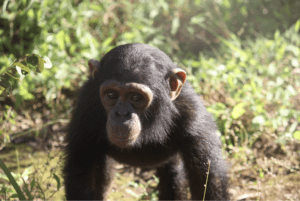
Chimpanzees are our closest living relatives, sharing about 98–99% of our DNA. They have highly expressive faces, capable of showing joy, fear, anger, and curiosity. Their long arms and strong hands make them exceptional climbers, allowing them to swing through the forest canopy with agility.
Chimpanzees are highly intelligent, using tools such as sticks to extract termites from mounds or rocks to crack nuts. They have complex vocalizations and gestures for communication, and their problem-solving skills are remarkable among non-human animals.
Their hands and feet are both adapted for grasping, giving them dexterity both on the ground and in trees.
How They Survive in Their Habitat
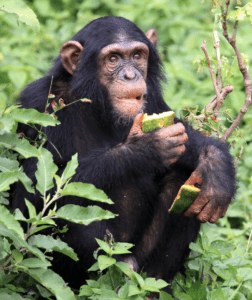
Chimpanzees live in tropical forests and savanna-woodlands, relying on a rich diet of fruit, leaves, seeds, insects, and occasionally small mammals. They forage both on the forest floor and in the canopy, taking advantage of seasonal availability of food.
They are highly adaptable and use tools to access hard-to-reach food sources. Social learning allows knowledge about food sources, tool use, and predator avoidance to pass between generations.
Strong social bonds help chimpanzees cooperate when hunting, defending territory, or caring for vulnerable group members. Their intelligence allows them to navigate complex forest ecosystems and respond to changing environmental conditions.
Family Life
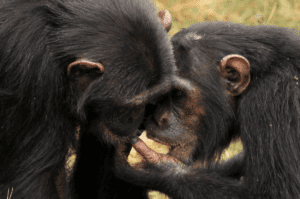
Chimpanzees live in large, fluid communities called fission-fusion societies, ranging from 20 to 150 individuals. Subgroups form and separate depending on food availability and social interactions.
Female chimpanzees typically care for their infants alone for the first few years, nursing and teaching them essential survival skills. Males establish dominance hierarchies, and alliances between males can influence group leadership. Grooming plays a crucial role in maintaining social bonds and reducing tension.
Community cooperation and strong family bonds are essential to survival, especially when defending territory or raising young.
Why They Are Threatened
Chimpanzees face multiple human-related threats. Deforestation for agriculture, logging, and infrastructure destroys and fragments their habitat.
Poaching for bushmeat and capture for the illegal pet trade has significantly reduced wild populations. Diseases, sometimes transmitted from humans, also threaten their survival, as chimpanzees are highly susceptible to many human pathogens.
The combination of habitat loss, hunting, and disease, coupled with slow reproductive rates, makes their conservation urgent.
Ten Fun Facts
- Chimpanzees share 98–99% of DNA with humans.
- They can make and use tools to access food.
- Chimpanzees communicate with facial expressions, gestures, and vocalizations.
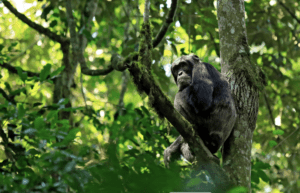
- They are excellent climbers and spend significant time in trees.
- Grooming strengthens social bonds and reduces tension.
- Chimpanzees can hunt in coordinated groups.
- Mothers teach their young how to crack nuts and use sticks for termites.
- They have strong memories and can remember locations of fruit trees.
- Chimpanzees exhibit empathy and have been observed comforting distressed individuals.
- They are capable of solving complex problems and using rudimentary strategies.
What Can You Do to Help?
- Support organizations protecting chimpanzee habitats in Africa.
- Advocate against deforestation and habitat fragmentation.
- Oppose illegal wildlife trafficking and bushmeat hunting.
- Participate in or donate to sanctuaries and rehabilitation programs.
- Promote awareness of human-wildlife coexistence and conservation education.
- Support ecotourism initiatives that protect natural habitats.
- Reduce human disease transmission risks in areas where chimpanzees live.