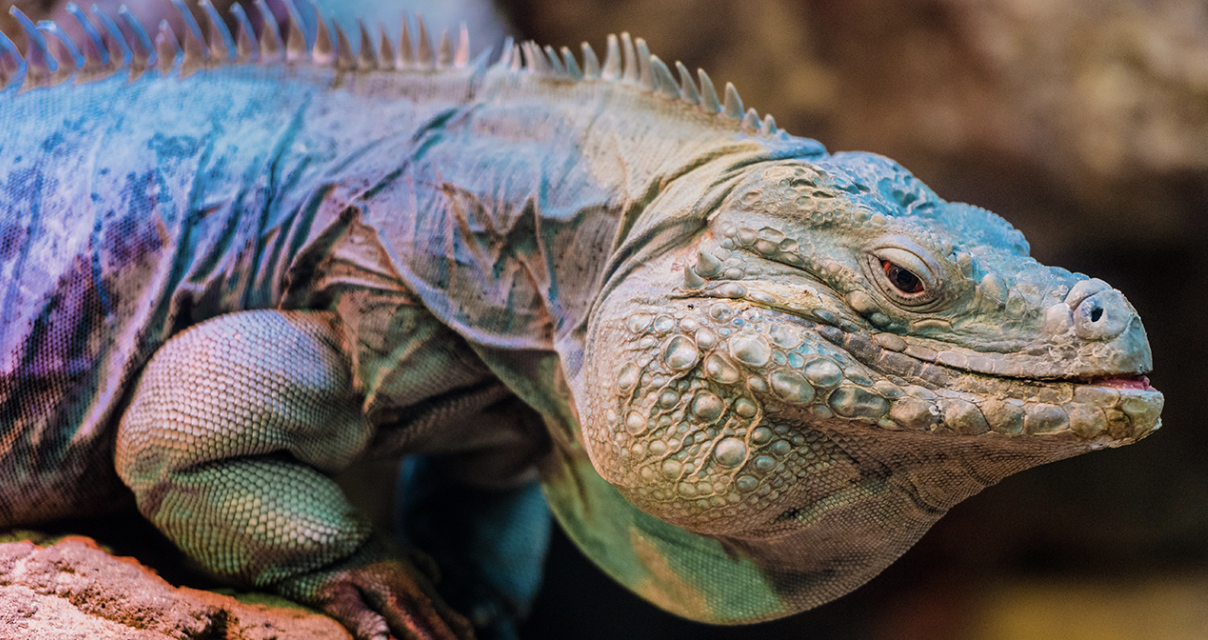
Quick Facts
- Official Species Name: Cyclura lewisi
- Estimated Population: Approximately 1,000 individuals in the wild
- Conservation Status: Endangered
- Range: Grand Cayman Island (Cayman Islands)
- Reasons for Population Decline: Habitat destruction, invasive predators, vehicle strikes, historical overhunting
The blue iguana is one of the largest native land animals on Grand Cayman and is known for its striking blue coloration, which becomes especially vivid in males during breeding season. Its body is heavy and muscular, with a crest of spines running down its back and a thick tail used for balance and defense. Despite their bold appearance, blue iguanas rely on camouflage among rocky forests and dry shrublands. They are primarily herbivores, feeding on leaves, flowers, fruits, and occasionally insects, playing an important role in seed dispersal across their ecosystem.
How They Survive in Their Habitat
Blue iguanas inhabit dry forests, shrublands, and rocky areas where they can bask in the sun to regulate their body temperature. As cold-blooded reptiles, they depend on sunlight to warm up before becoming active. They feed mainly on native plants, helping maintain healthy vegetation communities. They shelter in rock crevices, burrows, or hollow logs to avoid predators and extreme heat.
Family Life
Blue iguanas are generally solitary and territorial, especially males during breeding season. Females lay clutches of eggs in carefully dug nests in sandy soil, where the eggs incubate for about 65–90 days. Once hatched, the young receive no parental care and must immediately fend for themselves. Juveniles are particularly vulnerable to predators, and survival rates in the wild can be low without conservation protection.
Why They Are Threatened
The blue iguana once faced near extinction due to habitat destruction from development on Grand Cayman. Much of the island’s dry forest was cleared for roads, housing, and agriculture. Invasive species such as feral cats and dogs prey on young iguanas and eggs. Vehicle strikes are also a significant threat as road networks expand into their habitat. Although conservation programs have helped increase their numbers, the species remains vulnerable due to its limited range on a single island.
Ten Fun Facts
- Blue iguanas can live more than 40 years in the wild.
- Their blue color intensifies when they are warm or excited.
- They are found naturally only on Grand Cayman.
- Blue iguanas are excellent climbers when young.
- They can grow up to 5 feet (1.5 meters) long including the tail.
- Males are generally larger than females.
- They were once reduced to fewer than 25 individuals in the wild.
- Conservation breeding programs helped bring them back from the brink of extinction.
- They play an important role in spreading seeds through their droppings.
- Blue iguanas are considered a national symbol of the Cayman Islands.
What You Can Do to Help
- Support island conservation and habitat restoration programs.
- Donate to organizations protecting endangered reptiles.
- Avoid supporting the illegal wildlife trade.
- Promote responsible tourism that protects fragile island ecosystems.
- Advocate for invasive species control efforts.
- Raise awareness about island species that are found nowhere else on Earth.