Quick Facts
• Official Species Name: Leopardus wiedii
• Estimated Population: Unknown, but declining in many areas
• Conservation Status: Near Threatened
• Range: Mexico, Central America, and northern & central South America
• Reasons for Population Decline: Deforestation, habitat fragmentation, illegal pet trade, road mortality
Unique Features
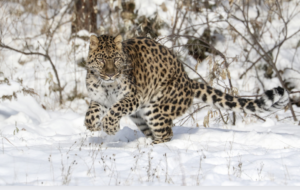
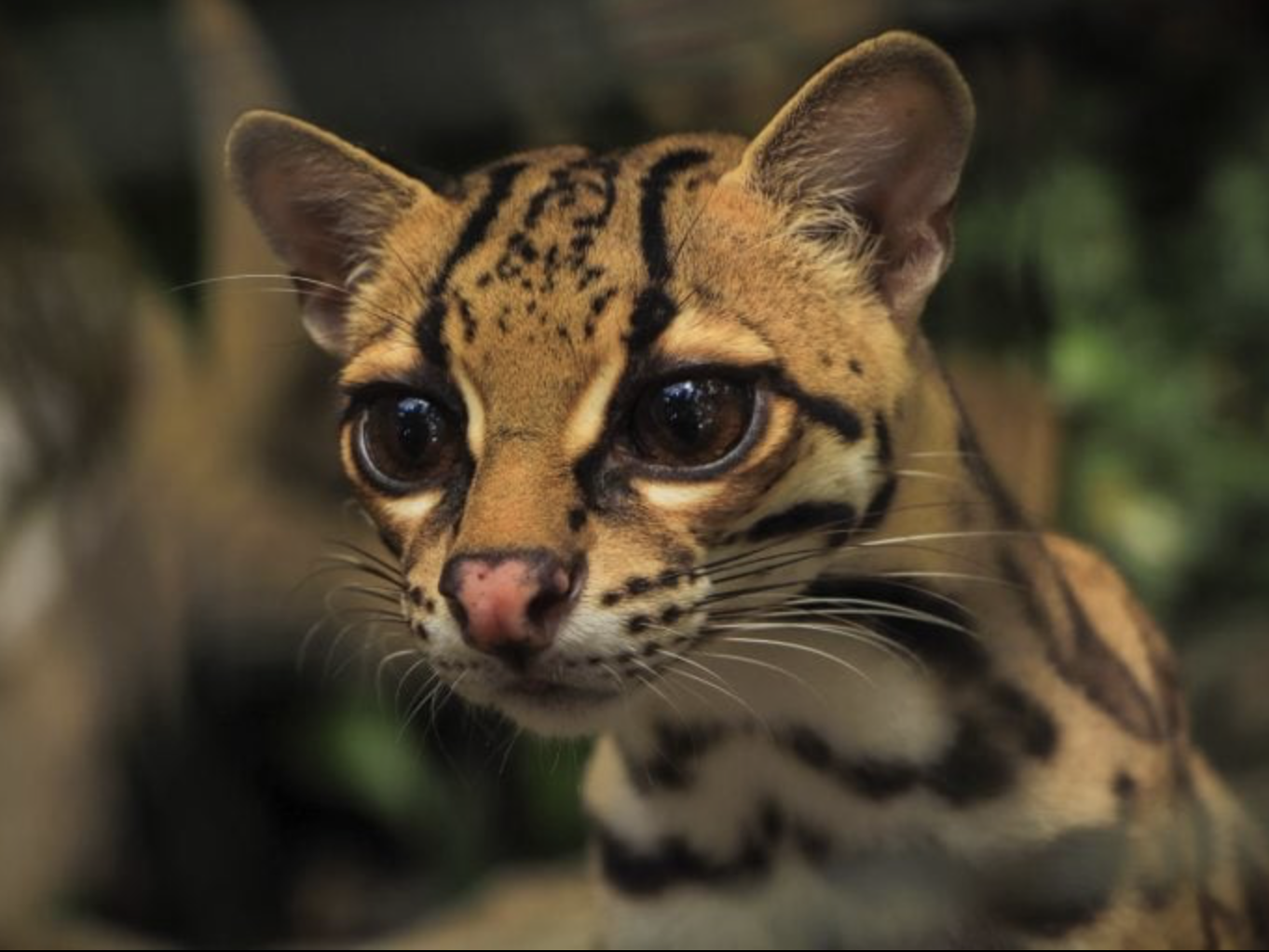
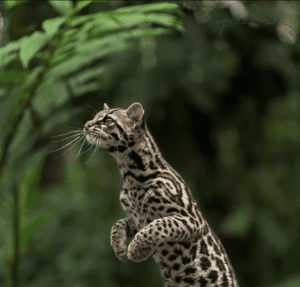
The margay is a small wild cat specially adapted for life in the trees. It has exceptionally large eyes for enhanced night vision and a long tail that helps it balance high in the forest canopy. Unlike most cats, the margay can rotate its hind ankles up to 180 degrees, allowing it to climb down trees headfirst. Its beautifully patterned coat, covered in rosettes and spots, provides camouflage in dappled forest light.
How They Survive in Their Habitat
Margays live primarily in dense tropical and subtropical forests, spending much of their lives in trees rather than on the ground. They are nocturnal hunters, preying on small mammals, birds, reptiles, and insects. Their agility allows them to leap between branches with precision, while their spotted coat helps them blend into shadows. Because they are highly arboreal, intact forest canopy is essential for their survival.
Family Life
Margays are solitary except during mating. After a gestation period of about 76–85 days, a female usually gives birth to one kitten. The mother raises the young alone, teaching it how to climb and hunt. Kittens remain with their mother for up to a year before becoming independent.
Why They Are Threatened
Habitat loss is the greatest threat to margays, as tropical forests are cleared for agriculture, cattle ranching, and development. Because they depend heavily on connected forest canopy, fragmentation limits their movement and access to prey. In the past, margays were hunted extensively for their fur, and today they are sometimes captured for the illegal pet trade. Road expansion also increases mortality in some regions.
Ten Fun Facts
-
Margays can rotate their hind feet 180 degrees.
-
They can climb down trees headfirst.
-
They spend most of their lives in trees.
-
Their eyes are proportionally larger than most wild cats.
-
They can leap up to 12 feet between branches.
-
Each margay’s coat pattern is unique.
-
They are excellent night hunters.
-
Margays are smaller than ocelots but look similar.
-
They have long tails for balance.
-
They play an important role in controlling forest prey populations.
What You Can Do to Help
• Support rainforest conservation efforts.
• Choose products that are certified deforestation-free.
• Avoid supporting the illegal wildlife trade.
• Donate to organizations protecting tropical forests.
• Advocate for wildlife corridors that connect fragmented habitats.
• Promote sustainable agriculture practices.
• Raise awareness about lesser-known wild cat species.