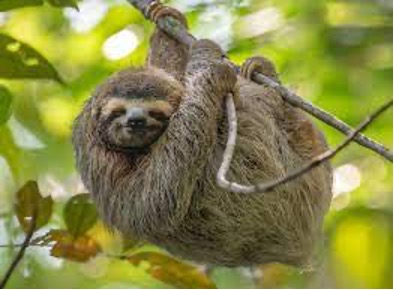
Quick Facts
-
Official Species Name: Bradypus (Three-toed sloths) & Choloepus (Two-toed sloths)
-
Estimated Population: Varies by species; some populations are stable, while others (such as the pygmy three-toed sloth) have fewer than 1,500 individuals remaining
-
Conservation Status: Ranges from Least Concern to Critically Endangered, depending on the species
-
Range: Central & South America
-
Reasons for Population Decline: Habitat loss, deforestation, illegal wildlife trafficking, road mortality, habitat fragmentation

Unique Features
Sloths are one of the most specialized mammals in the world. Their famously slow movement is not laziness — it is an evolutionary survival strategy. By moving slowly, they avoid attracting the attention of predators such as jaguars and large birds of prey. Their metabolism is extremely slow, allowing them to survive on a low-calorie diet of leaves.
Their long, curved claws act like natural hooks, enabling them to hang effortlessly from tree branches for hours at a time. Special tendons lock their grip in place, so they can sleep while hanging upside down without falling. Sloths also have a unique relationship with algae that grows on their fur. This gives them a greenish tint that helps camouflage them in the rainforest canopy, blending them almost perfectly with the surrounding leaves.
How They Survive in Their Habitat
Sloths spend nearly their entire lives high in the trees of tropical rainforests. The canopy provides food, shelter, and protection. Their slow movements and natural camouflage make them difficult for predators to spot. Instead of fleeing quickly, sloths rely on staying unnoticed.
Their digestive system is specially adapted to break down tough leaves. A sloth’s stomach has multiple compartments and can take weeks to fully digest a single meal. This slow digestion matches their low-energy lifestyle. Although they appear awkward on land, sloths are surprisingly good swimmers and can move three times faster in water than on the ground. In flooded forests or during heavy rains, swimming becomes an important survival skill.

Family Life
Sloths are generally solitary animals and prefer to live alone in their own section of forest. They communicate occasionally through soft vocalizations, especially during mating season.
Females typically give birth to one baby at a time after a gestation period of several months. The baby clings tightly to its mother’s chest for the first months of life, nursing and learning essential survival skills. Young sloths learn which leaves are safe to eat by observing and even licking food from their mother’s mouth. After about six months, they gradually become more independent but may stay near their mother’s territory for some time before establishing their own home range.
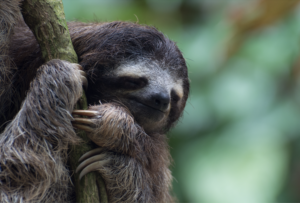
Why They Are Threatened
The greatest threat to sloths is deforestation. Rainforests are being cleared for agriculture, cattle ranching, logging, and development. When trees are cut down, sloths lose not only their homes but also their food sources.
Habitat fragmentation is especially dangerous. When forests are broken into smaller patches, sloths are sometimes forced to descend to the ground to move between trees, exposing them to predators, domestic animals, and vehicle collisions. In some regions, sloths are also victims of illegal wildlife trafficking, captured for the pet trade or exploited for tourism photos.
Because sloths reproduce slowly and have only one baby at a time, their populations cannot quickly recover from major losses.