Quick Facts
- Official Species Name: Muntiacus vuquangensis
- Estimated Population: Unknown, but believed to be very small and declining
- Conservation Status: Critically Endangered
- Range: Annamite Mountains of Laos and Vietnam
- Reasons for Population Decline: Heavy snaring, habitat loss, illegal wildlife trade
Unique Features
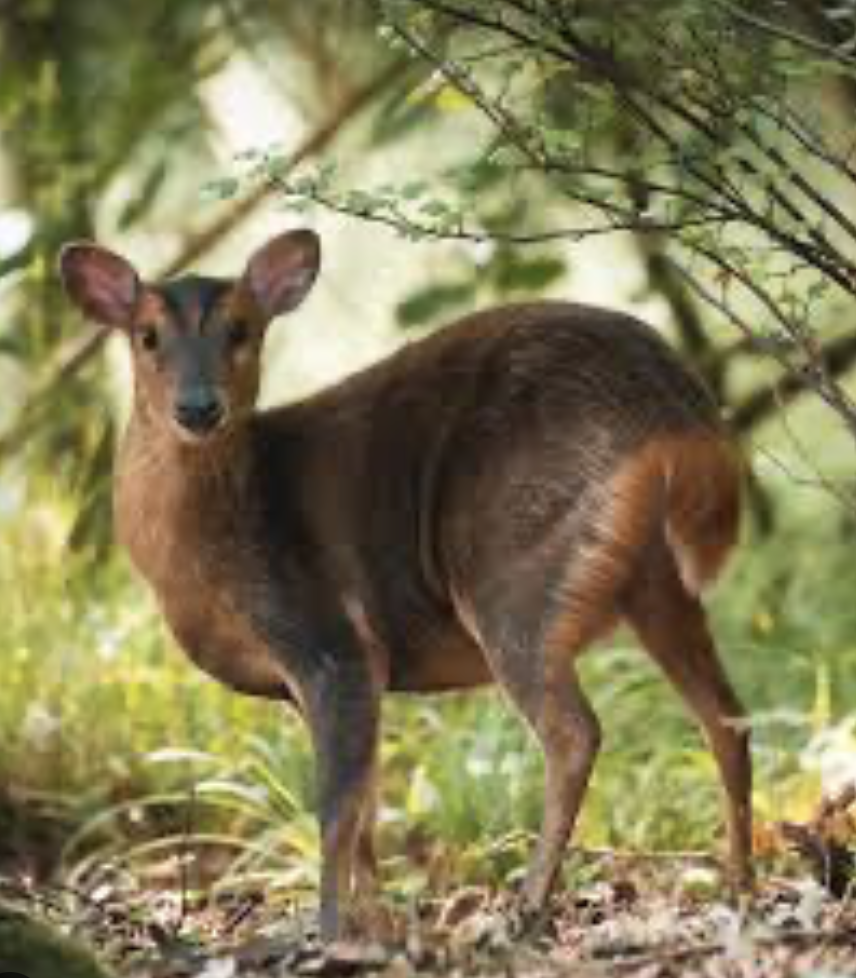
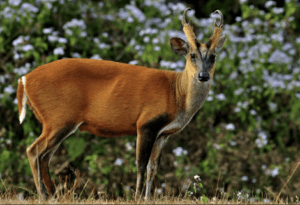
The giant muntjac is one of the rarest and most mysterious deer species in the world. Discovered as recently as 1994, it surprised scientists because large mammals are rarely newly identified. Its existence highlights how little we still know about remote forest ecosystems.
Unlike most deer, giant muntjacs have relatively small antlers but long, sharp canine teeth that protrude slightly from the mouth, especially in males. These tusk-like teeth are used in territorial disputes and fights. Their sturdy body and reddish-brown coat allow them to move quietly and blend into dense forest environments.
They also have scent glands on their faces, which they use to mark territory and communicate with other muntjacs in their range.
How They Survive in Their Habitat
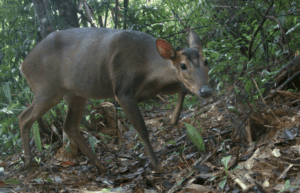
Giant muntjacs live in dense, humid evergreen forests in the Annamite Mountains, one of the most biodiverse and rugged regions in Southeast Asia. The thick undergrowth provides both food and protection from predators.
They are primarily ground-dwelling and move slowly and cautiously through the forest floor. Their diet includes leaves, shoots, grasses, fruits, and possibly fungi. This varied diet allows them to adapt to seasonal changes in food availability.
Their secretive nature is one of their greatest survival tools. They are rarely seen in the wild, and much of what we know about them comes from camera trap footage. Their ability to remain hidden helps them avoid both predators and human detection.
Family Life
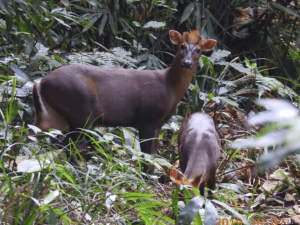
Very little is known about the giant muntjac’s social behavior due to its elusive nature. However, it is believed to be mostly solitary, coming together only during mating periods.
Males likely maintain territories and may compete for access to females using both their antlers and elongated canine teeth.
Females give birth to a single fawn, which remains hidden in dense vegetation for protection during its early life. This hiding behavior reduces the risk of predation while the young animal is most vulnerable.
Why They Are Threatened
The greatest threat to the giant muntjac is widespread snaring across Southeast Asia. Thousands of wire snares are set in forests to capture animals for the illegal wildlife trade, and muntjacs are frequently caught unintentionally.
Habitat loss from logging, agriculture, and infrastructure development is also reducing the amount of suitable forest available. As forests become fragmented, populations become isolated, making survival more difficult.
Because the species already exists in very low numbers and has a limited range, even small increases in hunting pressure can have devastating consequences. The giant muntjac is now considered one of the most threatened large mammals in the region.
Ten Fun Facts
- The giant muntjac was discovered in 1994.
- It is one of the largest muntjac species.
- Males have long canine teeth that act like tusks.
- It lives in the remote Annamite Mountains.
- It is rarely seen in the wild.
- Camera traps are the main way scientists study it.
- It likely communicates using scent marking.
- Its reddish coat helps it blend into forest environments.
- It is sometimes called the “Asian unicorn” due to its rarity.
- It is one of the most endangered deer species in the world.
What Can People Do to Help?
- Support organizations working to remove snares from Southeast Asian forests.
- Advocate for stronger anti-poaching enforcement.
- Promote sustainable forestry and reduce deforestation.
- Avoid products linked to illegal wildlife trade.
- Support protected areas in Laos and Vietnam.
- Raise awareness about lesser-known endangered species.
- Donate to conservation programs focused on the Annamite Mountains.