
Quick Facts
-
Official Species Name: Delphinapterus leucas
-
Estimated Population: ~150,000 globally (some populations critically low)
-
Conservation Status: Least Concern globally; some populations Endangered
-
Range: Arctic & Sub-Arctic regions
-
Reasons for Population Decline: Climate change, pollution, industrial development, noise disturbance

Unique Features
Beluga whales are often called the “canaries of the sea” because of their wide range of whistles, clicks, chirps, and other vocal sounds. They are one of the most vocal marine mammals, using sound not only for communication but also for navigation.
Unlike most whales, belugas have flexible neck vertebrae, allowing them to turn their heads side to side — giving them expressive facial movements. Their white coloration helps them blend into Arctic sea ice, offering camouflage from predators like polar bears and orcas.
A thick layer of blubber, sometimes up to six inches thick, protects them from freezing Arctic waters and serves as an energy reserve.
How They Survive in Their Habitat
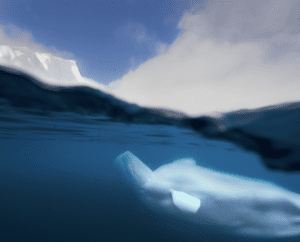
Belugas are highly adaptable and live in both deep offshore waters and shallow coastal areas. They use echolocation to locate fish and navigate through ice-covered waters.
They migrate seasonally, following shifting sea ice and prey populations. In summer, many populations move into estuaries and river mouths to molt their skin and give birth in relatively warmer, protected waters.
Their strong social bonds increase survival, as pod members cooperate and share information about food sources and migration routes.
Family Life
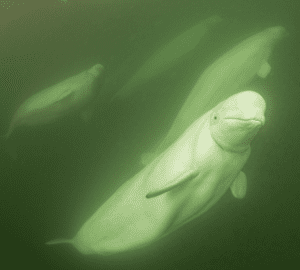
Belugas live in social groups called pods, which can range from a few individuals to hundreds. Mothers give birth to a single calf every 2–3 years. Calves are born gray and gradually turn white as they mature.
Young belugas remain close to their mothers for several years, learning migration paths and hunting techniques. Social learning plays a major role in their survival.
Why They Are Threatened
Climate change is rapidly melting Arctic sea ice, altering migration routes and food availability. Increased shipping traffic and oil and gas exploration introduce noise pollution that interferes with beluga communication and navigation.
Pollutants accumulate in Arctic waters and build up in belugas’ blubber, affecting reproduction and immune health. Some isolated populations are declining rapidly due to these combined pressures.
10 Fun Facts
- Belugas are born gray and turn white as adults.
- They can mimic sounds.
- They shed their skin each summer.
- They use echolocation to hunt.
- They can dive up to 2,300 feet.
- They live up to 60 years.
- They migrate seasonally.
- They are highly social animals.
- Their blubber can be up to 6 inches thick.
- They are one of the most vocal whale species.