Quick Facts
- Official Species Name: Diceros bicornis
- Estimated Population: Approximately 6,000 individuals remaining
- Conservation Status: Critically Endangered
- Range: Eastern and Southern Africa
- Reasons for Population Decline: Poaching for horns, habitat loss, human-wildlife conflict
Unique Features
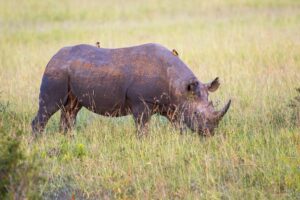
The black rhino is a large, powerful herbivore known for its hooked upper lip, which it uses to grasp and pull leaves from shrubs and bushes. Despite its name, it is actually gray in color, similar to the white rhino.
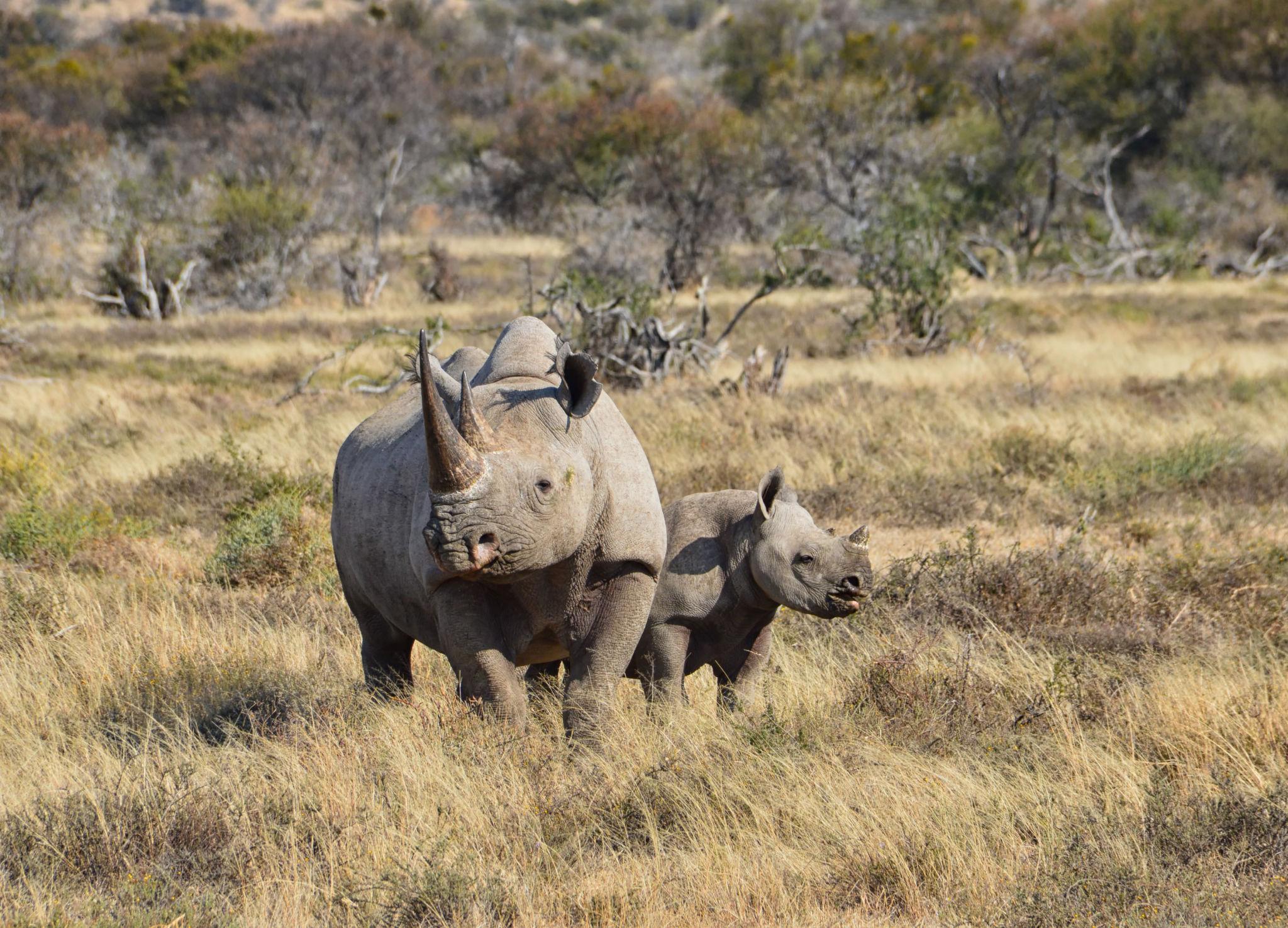
Black rhinos have two horns made of keratin (the same material as human fingernails), with the front horn often growing longer and used for defense.
They have relatively poor eyesight but an excellent sense of smell and hearing, helping them detect danger in their environment.
Compared to white rhinos, black rhinos are smaller and more aggressive, especially when startled.

How They Survive in Their Habitat
Black rhinos live in savannas, grasslands, and dense shrublands, where they can find plenty of bushes and trees to feed on.
They are browsers, meaning they eat leaves, twigs, and branches rather than grass. Their pointed lips allow them to selectively feed on specific plants.
They are mostly solitary and are often active during the early morning, evening, or night to avoid the heat.
Black rhinos use well-established paths and have territories they mark with dung and urine to communicate with other rhinos.
Family Life
Black rhinos are generally solitary animals. Adult males live alone, while females may be accompanied by their calves.
After a gestation period of about 15–16 months, a female gives birth to a single calf.
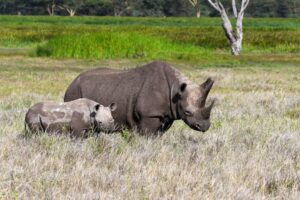
The calf stays close to its mother for protection and learns essential survival skills, remaining with her for 2–3 yearsbefore becoming independent.
Mothers are highly protective and will aggressively defend their young from threats.
Why They Are Threatened
The biggest threat to black rhinos is poaching. Their horns are illegally traded for use in traditional medicine and as status symbols, despite having no proven medical value.
Habitat loss due to agriculture and human expansion has also reduced the areas where black rhinos can live safely.
Civil unrest and lack of enforcement in some regions make it difficult to fully protect them from poachers.
Although conservation efforts have helped populations recover slightly, black rhinos remain critically endangered.
Ten Fun Facts
- Black rhinos can run up to 34 miles per hour (55 km/h).
- Their horns are made of keratin, like human hair and nails.
- They use their lips like fingers to grab food.
- Black rhinos have poor eyesight but excellent hearing and smell.
- They can become very aggressive if they feel threatened.
- Each rhino has a unique horn shape and size.
- Oxpecker birds often sit on rhinos and help remove parasites.
- They communicate through scent markings and vocal sounds.
- A group of rhinos is called a “crash.”
- They play a key role in shaping vegetation and maintaining ecosystems.
What Can You Do to Help?
- Support organizations protecting rhinos and funding anti-poaching units.
- Never purchase products made from rhino horn.
- Advocate for stronger wildlife protection laws.
- Support sustainable tourism that benefits conservation efforts.
- Raise awareness about the illegal wildlife trade.
- Donate to conservation programs working in Africa.