
Green Sea Turtles
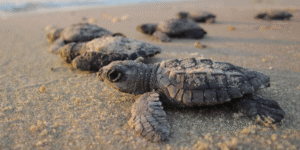
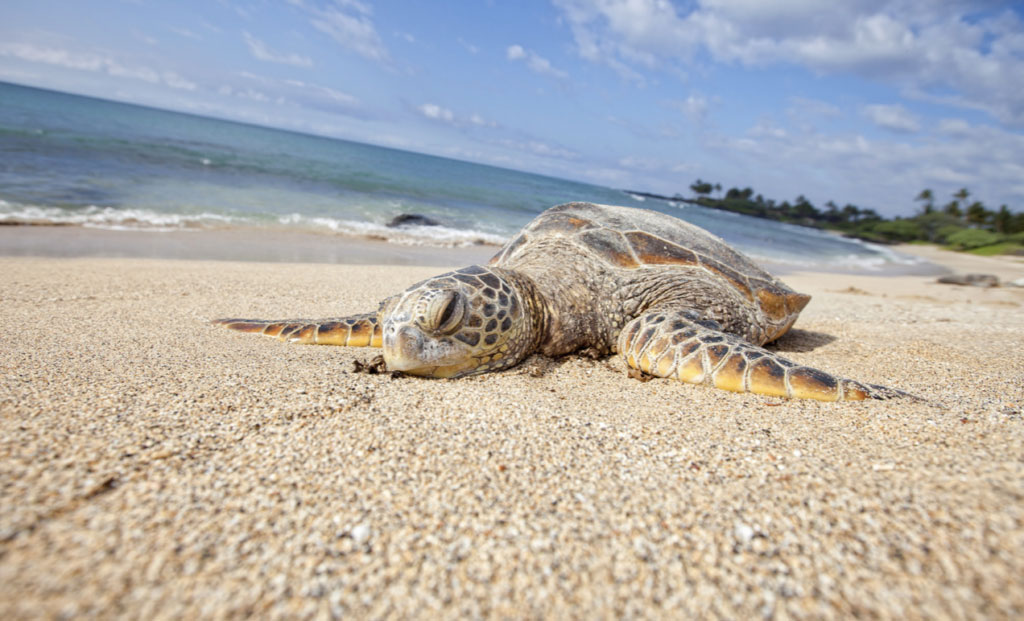
Surrounding the warm coastline of Raine Island off the Great Barrier Reef, hundreds of Green Sea Turtles wait to nest their eggs. At their peak, 60,000 females will nest in this area along with thousands of other females around the world.
Weighing in about 300 bounds, with the ability to live upwards of 70 years, they are distinguished by their unique coloring. Since the 1980s, their numbers have been rebounding as a symbol of conservation success. Since the Endangered Species act nesting green sea turtle numbers have greatly improved, showing the power of governmental action in the preservation of endangered species

In 1989 Florida beaches saw an estimated 464 nests as compared to 39,000 in 2017 after the 1978 Endangered Species Act was implemented. Previously hunted for their fat, shells, and eggs, the Act put a crucial ban on hunting these ocean animals. But the fight for their protection is not finished. Like many marine animals, they are still threatened by the impending threat of climate change, vessel strikes, ocean pollution, and bycatch. Though hope is still evident, governmental action does work, the green sea turtle is an example of it. We must continue to support marine life through the continued protection of our oceans on an international scale. You can do your part by respecting coral reefs, keeping your distance, and protecting our oceans against pollution.
Channel Island Fox
The Channel Island Fox is endemic to the coast of Southern California. Facing dramatic decline from unnatural predation as a consequence of human development and expansion, they faced extinction in the 1990s. Feral pigs, not native to the area attracted nesting golden eagles.

To save these small carnivores, the Channel Island National Park began a conservation program that included captive breeding, reintroduction, ethical removal of golden eagles, and other organized efforts. These conservation efforts prioritized returning ecosystems to their natural state. Successfully they were able to raise the number of Channel Island Foxes to 1302 in Santa Cruz, 516 in San Miguel, and 292 in Santa Rosa.
Cross River Gorillas
With only 300 Cross River gorillas left in the world, conservation efforts have a long way to go to save these critically endangered primates. But there is hope. In 2020, conservationists were able to capture a video of a group of seven Cross River gorillas. This rare glimpse provides hope their numbers are growing, as they are usually deeply hidden within the forest of Nigeria and Cameroon.

Cross River Gorilla Conservation and local communities are doing their part in protecting the Cross River gorilla. Their skilled and comprehensive approach includes forest monitoring, community education and development, protection training, and more. The bushmeat trade, poaching, and habitat loss are very real threats to the remaining Cross River gorilla population, but through exhaustive conservation, work hope prevails.
What Do These Stories Teach Us?
Conservation stories teach us that hope is necessary, even in the hardest of times. Whether the population of a species is rebounding or declining there is still hope as long as people care and show they care. Stories of success show the world that conservation efforts by governments, NGOs, and communities are powerful.
Climate change, habitat destruction, and poaching are all human activities that we have the chance to stop through laws, education, and community development. Donations, voting, and cleaning up your own community are beneficial to these species – even if you don’t see it directly. Animals are unable to protect themselves against human destruction, so it reasons that it must be human intervention, human hope that will save them in the end. The success of the Green Sea Turtle, the Channel Island Fox, and hopefully the Cross River gorilla prove that when people care, they can truly make a difference.
References
- https://www.fisheries.noaa.gov/species/green-turtle
- https://www.biologicaldiversity.org/news/press_releases/2019/marine-mammals-and-sea-turtles-01-16-2019.php
- https://www.nature.org/en-us/get-involved/how-to-help/animals-we-protect/santa-cruz-island-fox/
- https://www.nps.gov/chis/learn/nature/island-fox.htm
- https://www.nps.gov/chis/learn/nature/fox-saving.htm
- https://www.openaccessgovernment.org/nine-conservation-success-stories-2020/91477/
- https://crossrivergorilla.org/