
Home » Striped Hyena
The historical range of the striped hyena included Africa north of and including the Sahel zone, eastern Africa south into Tanzania, the Arabian Peninsula and the Middle East up to the Mediterranean Sea, Turkey, Iraq, the Caucasus (Azerbaijan, Armenia, Georgia), Iran, Turkmenistan, Uzbekistan, Tajikistan, Afghanistan (except the Hindukush) and the Indian Subcontinent.
In most regions, the species’ distribution is patchy today, indicating that it exists in many isolated populations, particularly in most of West Africa, most of the Sahara, sections of the Middle East, the Caucasus, and central Asia.
It does, however, have a wide range of distribution over Ethiopia, Kenya, and Tanzania. Its current distribution in Pakistan, Iran, and Afghanistan is uncertain, but it is thought to exist in huge numbers in open parts of India’s Deccan Peninsula. Periodic sightings were recorded in Kandahar Province during the current Afghanistan battle, though not conclusively.
The striped hyena is predominantly a nocturnal species, leaving its den only when total darkness falls and returning before daylight. Striped hyenas are usually found alone or in pairs, though in Libya, groups of up to seven animals have been observed.
They are not typically territorial animals, and the home ranges of different groups frequently overlap. The Serengeti’s home ranges range from 17 sq mi to 28 sq mi, whereas the Negev’s home range is 24 sq mi). When marking their territory, striped hyenas use the paste of their anal pouch (hyena butter) to scent mark grass, stalks, stones, tree trunks and other objects. The black patch near the thoracic and lumbar vertebrae is erected during aggressive confrontations. Striped hyenas bite at the throat and legs when fighting, but not at the mane, which functions as a signaling system.
They kiss each other’s mid-back regions, sniff each other’s noses, extrude their anal pouches, or claw each other’s throats when welcoming each other.
The species is not as vocal as the spotted hyena, with only a chattering chuckle and howling as vocalizations.
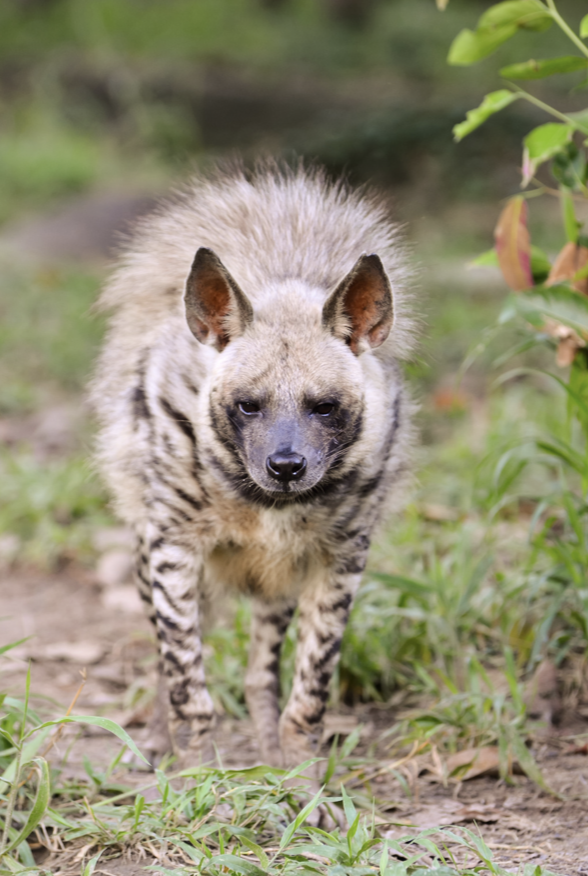
For an animal of its size, the winter coat is extraordinarily long and consistent, with a luxuriant mane of stiff, long hairs running down the back from the occiput to the base of the tail. The coat is coarse and bristly in general, though this changes depending on the season. The coat is dense, velvety, and has well-developed
underfur in the winter. The guard hairs on the flanks are 50–75 mm long, the mane is 150–225 mm long, and the tail is 150 mm long. The coat is significantly shorter and coarser in the summer, and there is no underfur, however the mane remains enormous. The coat is usually filthy-brownish grey or dirty grey in the winter. The mane has light grey or white hairs at the base and black or dark brown hairs at the tips. While the muzzle is dark, greyish brown, brownish-grey, or black, the top of the head and cheeks are lighter in color. The ears are nearly black in color. On the front of the neck, there is a huge black mark separated from the chin by a light zone. From the flanks to the back of the cheeks, a black field ascends. Small dark patches and transverse stripes cover the inner and outer surfaces of the forelegs.
Hyaena hyaena
5,000 to 14,000
Near Threatened
North and East Africa, the Middle East, the Caucasus, Central Asia and the Indian subcontinent.
Habitat destruction
Overhunting
Human encroachment on their habitat

A community garden is a wonderful way to bring people together while growing fresh, healthy food. Kids can ask their school, local library, or community center if there’s space to start a garden, then invite neighbors and classmates to help plant, water, and harvest vegetables or flowers. Some gardens even donate their extra produce to food banks or share it with neighbors who need it. It’s a hands-on way to learn about nature, teamwork, and taking care of your community’s shared spaces.
Wildlife centers take care of injured or orphaned animals, and they always need extra support to keep helping. Kids can host a bake sale, lemonade stand, or online fundraiser, or organize a “walk-a-thon” with friends and family to raise money for a wildlife rescue near them. You could also collect donated supplies the center needs, like towels, blankets, or pet food. Even a small donation can help feed, shelter, or heal an animal in need.
Recycling projects let kids turn everyday trash into something useful — or at least keep it out of landfills! You could start a recycling bin program at your school, organize a can and bottle drive to raise money for charity, or get creative and turn old materials into art, planters, or bird feeders. You might even research your town’s recycling rules and make a poster or flyer to help neighbors recycle correctly. Small habits, like rinsing containers or separating paper from plastic, add up to a big impact when a whole community joins in.
Setting up a booth at your local farmers market is a great way to get your whole neighborhood excited about helping the planet. You could raise money for a cause you care about — like a wildlife shelter, a tree-planting group, or a beach cleanup fund — by selling homemade crafts, lemonade, or baked goods. You could also use your booth to teach people about recycling, showing them fun facts or simple tips for sorting their trash the right way. It’s a great way to practice public speaking, teamwork, and making a real difference in your community.
Every year on the third Saturday of September, people around the world celebrate International Coastal Cleanup Day, and you can sign up with local groups in your community to join thousands of other volunteers picking up trash along the shore. But you don’t have to wait for that one day — cleanups can happen any time! Grab some gloves, trash bags, and a few friends, and organize your own cleanup day at a nearby river, stream, lake, or beach. It’s a fun way to hang out with friends while protecting fish, turtles, and birds from plastic and litter. Nationalcleanupday.
Planting trees is one of the easiest ways kids can help fight climate change and give animals a home. You can join organizations like SAFE Worldwide, One Tree Planted, or the Arbor Day Foundation, which often have kid-friendly volunteer days and even let you sponsor a tree from home. Or, team up with your family, neighbors, or scout troop to start your own mini tree-planting project in a local park, schoolyard, or empty lot (just ask permission first!). Every tree you plant helps clean the air, cool the planet, and grow into a home for birds and squirrels for years to come.