
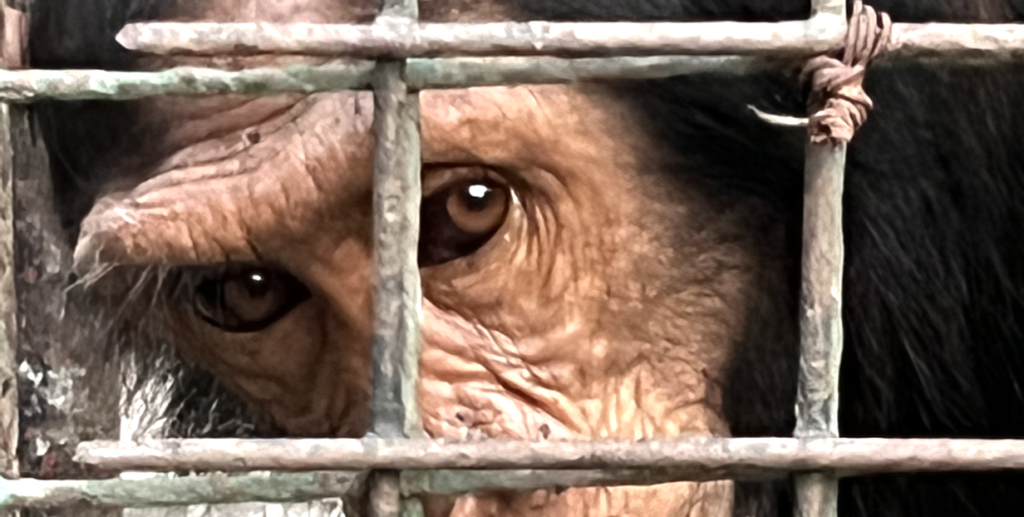
Look at him
Do you see his mother’s blood spill onto his fur?
His face buried in her limp body unable to muffle
his family’s screams ringing through the rainforest,
rifle shots and the thud of ten bodies to the ground.
Machetes carve through the chimpanzee troop
to him.
His little fingers cling to his mother’s arm
as a boot rolls her over and
a stranger peels him away.
His mother’s devoted embrace replaced
by chains indenting his skin,
padlocked to a fate he no longer owns.
Car doors slam shut and through the slits of a crate
he stares into darkness as black as the market that demands him
with trauma as embedded as the bullet in his bones.
Listen to her
Do you hear theft’s sinister whisper?
Nothing but a bird barely breathing inside a suitcase.
Her voice disabled by drugs
beak taped shut and wings cracked
in criminal secrecy.
All her wildness stuffed in a toilet paper roll
as if she is disposable and not endangered,
stacked atop dozens of other tropical prisoners
each crammed in their own cardboard casket,
buried alive but not for long
because theft has not only an undertone but
a death sentence.
No food no water and no other survivors.
Her eyes dart in the dark with a jolt of turbulence
as a fledgling bleeds out beside her.
Millions more
across the animal kingdom are
ripped from their homes and strung out
across continents,
each being connected not by blood
but blood shed.
A human can so carelessly trade someone’s future
for currency
creating a wicked equivalent
between life and merchandise
at the expense of entire ecosystems
for fascination
purchasing a once wild animal for their home
while their child’s stuffed toy flung on the floor
has more freedom
for entertainment
exploiting a neglected collection of
enfeebled bodies and splintered instincts
in rows of solitary confinement called a roadside zoo.
Do you see him?
He survived an atrocity to slump in a cage,
his intelligence shackled and succumbing
to the madness and apathy of imprisonment.
Do you hear her?
She was plucked from a gene pool too small to recover
and now crestfallen in solitude she sings
the requiem of a species.
The exotic pet trade.
It is a degrading scam
because a pet
is not born in the rainforest
stolen from the canopy
reliant on wilderness,
because trade
is quite a gracious term for torture.
And yet it is the animals who are locked up
to serve an unnatural life sentence
for human crimes
concealed by ignorance and corruption.
The wild is waiting for witnesses.
Conservationist and Sr staff writer for SAFE Worldwide
Disclaimer: The opinions, beliefs and viewpoints expressed by the various authors and forum participants on this web site are their own and do not necessarily reflect the opinions, beliefs and viewpoints of SAFE Worldwide.

A community garden is a wonderful way to bring people together while growing fresh, healthy food. Kids can ask their school, local library, or community center if there’s space to start a garden, then invite neighbors and classmates to help plant, water, and harvest vegetables or flowers. Some gardens even donate their extra produce to food banks or share it with neighbors who need it. It’s a hands-on way to learn about nature, teamwork, and taking care of your community’s shared spaces.
Wildlife centers take care of injured or orphaned animals, and they always need extra support to keep helping. Kids can host a bake sale, lemonade stand, or online fundraiser, or organize a “walk-a-thon” with friends and family to raise money for a wildlife rescue near them. You could also collect donated supplies the center needs, like towels, blankets, or pet food. Even a small donation can help feed, shelter, or heal an animal in need.
Recycling projects let kids turn everyday trash into something useful — or at least keep it out of landfills! You could start a recycling bin program at your school, organize a can and bottle drive to raise money for charity, or get creative and turn old materials into art, planters, or bird feeders. You might even research your town’s recycling rules and make a poster or flyer to help neighbors recycle correctly. Small habits, like rinsing containers or separating paper from plastic, add up to a big impact when a whole community joins in.
Setting up a booth at your local farmers market is a great way to get your whole neighborhood excited about helping the planet. You could raise money for a cause you care about — like a wildlife shelter, a tree-planting group, or a beach cleanup fund — by selling homemade crafts, lemonade, or baked goods. You could also use your booth to teach people about recycling, showing them fun facts or simple tips for sorting their trash the right way. It’s a great way to practice public speaking, teamwork, and making a real difference in your community.
Every year on the third Saturday of September, people around the world celebrate International Coastal Cleanup Day, and you can sign up with local groups in your community to join thousands of other volunteers picking up trash along the shore. But you don’t have to wait for that one day — cleanups can happen any time! Grab some gloves, trash bags, and a few friends, and organize your own cleanup day at a nearby river, stream, lake, or beach. It’s a fun way to hang out with friends while protecting fish, turtles, and birds from plastic and litter. Nationalcleanupday.
Planting trees is one of the easiest ways kids can help fight climate change and give animals a home. You can join organizations like SAFE Worldwide, One Tree Planted, or the Arbor Day Foundation, which often have kid-friendly volunteer days and even let you sponsor a tree from home. Or, team up with your family, neighbors, or scout troop to start your own mini tree-planting project in a local park, schoolyard, or empty lot (just ask permission first!). Every tree you plant helps clean the air, cool the planet, and grow into a home for birds and squirrels for years to come.